 No Code Jobs

Best Startup Lead Databases
A detailed comparison of startup lead databases with ranking criteria, feature matrices, pros and cons, and real conversion math for outbound sales teams targeting startups.
If you are trying to sell to startups, you do not have a “lead database problem”. You have a timing problem.
Hot take: database size is a distraction. A giant pool of contacts is nice for a slide deck, but it does not fix the real thing that kills outbound: stale data and bad timing. Freshness beats volume. Trigger beats “more records”. And yes, I am saying this after 20 years of selling into Silicon Valley.
Now let me switch gears mid-thought, because someone needs to say it plainly: if your list is old, your copy is irrelevant by default, and you are basically donating deliverability to Gmail. You can be a great writer and still lose.
This guide ranks the major options and shows how to turn “a list” into booked meetings with realistic numbers.
If your main filter is funding recency, start here first: Startups that just raised funding / Just Raised Funding
Table of contents
- How I rank lead databases
- Quick rankings
- Comparison summary table
- Feature matrix
- Deep dive reviews
- Real conversion logic
- Related “converter” suggestions
- Verdict
How I rank lead databases
Here are the criteria I actually care about, in order.
1) Freshness and trigger timing
Contact data decays fast. People change jobs, companies change domains, and startups pivot or get acquired. The best databases either:
- verify in real time, or
- anchor leads to a trigger event (funding, hiring spike, new org chart, new tech install).
2) Deliverability and verification
“Verified email” is not a perfect promise, but it is a start. If a tool gives you deliverability guarantees or double-verification, that is meaningful.
3) Fit for your motion
- If you sell a $3k per month product, you can survive with fewer leads but higher quality and better timing.
- If you sell a $99 self-serve tool, you need volume and cheap cost-per-contact.
4) Workflow friction
A database is only useful if it ships leads into your workflow:
- export (CSV)
- CRM sync
- API
- enrichment on existing lists
5) Compliance and region
EU outbound is a different game than US outbound. Some teams need GDPR-first workflows and phone-verified data.
6) Total cost, not list price
Credits, phone reveals, seat minimums, and annual contracts matter more than the homepage price.
Quick rankings
Best overall for “startups” (not just founders)
- Apollo.io (best all-around for startup outbound teams)
- ZoomInfo (best for enterprise-style account intelligence)
- UpLead (best for verified email accuracy when you are small and picky)
Best if your edge is timing
- JustRaisedFunding.com (best when funding recency is the point) - real-time funding alerts
Best if your edge is phone and EU compliance
- Cognism
Best if you live in LinkedIn all day
- Lusha
Comparison summary table
This table is meant to be practical. Prices and counts change. Use it to narrow down what to test.
| Tool | Typical starting price | Data scope (as advertised) | Best for | Main downside |
|---|---|---|---|---|
| JustRaisedFunding.com | $149/month | Funding-triggered startups; founder contacts; site shows fresh startup leads imported immediately | Narrower than a general B2B database | |
| Apollo.io | Starts around $49/user/month (annual) | Apollo advertises 275M+ verified contacts (some sources cite 210M+) | All-around outbound for small teams | Credits and “fair use” limits can surprise you |
| ZoomInfo | Often starts around $15k/year | ZoomInfo advertises 600M+ contacts and 135M+ companies (varies by package) | Deep account research and enterprise workflows | Expensive, usually annual, usually negotiated |
| Cognism | Often $15k/year and up (estimates) | Strong EU focus, phone-verified positioning | Phone-first teams, EU-heavy outbound | Price and contracts, not great for budget teams |
| UpLead | Starts at $99/month | Focus on verified emails; claims 95% accuracy for email verification | Teams that care more about bounce than volume | Smaller platform, fewer “all-in-one” features |
| Lusha | Free tier and paid plans (per-seat) | Lusha claims 280M contacts and added 100M verified contacts | Quick contact lookup from LinkedIn | Credits burn fast if you pull lots of phones |
Feature matrix
| Feature | JustRaisedFunding.com | Apollo.io | ZoomInfo | Cognism | UpLead | Lusha |
|---|---|---|---|---|---|---|
| Funding trigger leads | Yes | Limited (not core) | Indirect (not core) | Indirect (not core) | No | No |
| Real-time alerts | Yes | Not core | Not core | Not core | No | No |
| Verified emails focus | Yes (deliverability guarantee) | Mixed | Mixed | Strong | Strong | Mixed |
| Phone-first workflow | Some | Some | Strong | Strong | Some | Strong |
| Intent / activity signals | Traffic signals mentioned | Some | Strong (by package) | Some | No | No |
| CSV export | Yes | Yes | Yes | Yes | Yes | Yes |
| Works for tiny teams | Yes | Yes | Usually no | Usually no | Yes | Yes |
| Works for enterprise | Not the main use | Sometimes | Yes | Yes | Sometimes | Sometimes |
Deep dive reviews
1) JustRaisedFunding.com (best for startups that just raised)
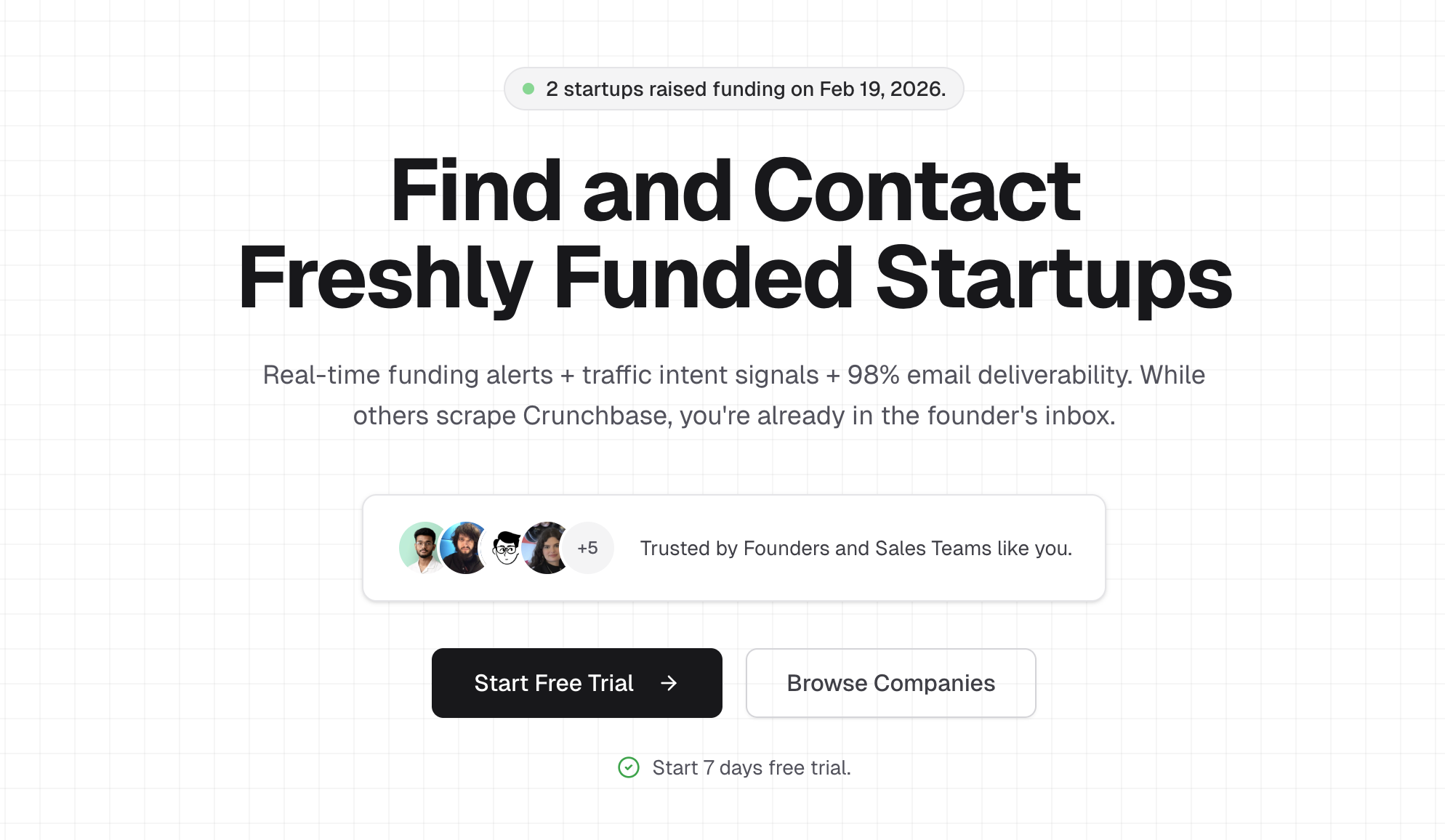
What it is A focused database for freshly funded startups. The site claims real-time funding alerts, traffic intent signals, and a 98% email deliverability guarantee. Pricing shown is $149/month with a 7-day free trial that includes 25 verified founder emails.
Why it matters Funding is a timing advantage. Startups that just raised are more likely to:
- buy tools
- hire vendors
- switch systems
- actually reply because they are staffing up and making decisions
Pros
- Built around the trigger event that matters most for startup selling: funding recency
- Founder contact focus (not just generic “marketing manager at a random company”)
- Deliverability guarantee and double verification messaging
- Clear pricing on the page, no demo-first trap
- Has free tools listed (email finder, verifier, founder LinkedIn search)
Cons
- If you sell to large enterprises or non-venture businesses, it is the wrong tool
- Smaller database than the mega platforms, by design
- You still need a real workflow (sequencing, CRM, tracking)
Who should use it
- Agencies selling to funded startups
- B2B SaaS targeting Seed through Series C buyers
- Recruiters who want a “who is hiring because they have budget” list
Who should not
- Teams that need millions of contacts across every industry
- Teams that primarily sell to public companies or non-VC markets
How I would use it
- Build a segment: “raised in last 14 days” + your niche
- Export founders and 1-2 functional leaders
- Run a short sequence that acknowledges the funding trigger
- Use it as the top-of-funnel feed, then enrich in your CRM
Internal link: If you want a step-by-step workflow for this play, read Startups that just raised funding.
2) Apollo.io (best all-around for startup outbound)
What it is Apollo tries to be both a database and an outbound platform. Pricing is published, with plans that commonly start around $49/user/month billed annually.
Apollo also has a credit model. This is where teams get surprised. The sticker price is rarely the true cost.
Pros
- Good balance of database + outbound workflow
- Strong for small teams that want one tool to do more than just export
- Flexible filters, list building, and sequencing
Cons
- Credits and limits matter more than the monthly price
- Any system that includes sequencing tempts teams to send too much too fast
- “Unlimited” usually comes with a policy and guardrails
Who should use it
- Startups running consistent outbound and willing to learn one platform
- Teams that want prospecting + sending in one place
Who should not
- Anyone who cannot control volume and deliverability
- Teams that need strict compliance workflows
Hot take Apollo is often “good enough” for years. That is the good news. The bad news is that “good enough” makes teams lazy. You stop improving targeting because the tool always has more contacts. Then you wonder why reply rates are low.
3) ZoomInfo (best for enterprise-style account intel)
What it is ZoomInfo is usually a bigger commitment: annual contracts, negotiated packages, and enterprise workflows. It positions itself as a large dataset with lots of attributes, plus integrations.
Pros
- Deep company profiles and account-level research
- Strong in North America in many industries
- Useful when your strategy is account lists and org charts, not just scraping emails
Cons
- Cost and contract friction
- Not built for a 2-person startup that wants to spend $200/month
- Easy to buy too much data and use too little
Who should use it
- Teams doing account-based selling with defined target account lists
- Companies where one deal pays for the platform
Who should not
- Early-stage startups that do not yet have a tight ICP and messaging discipline
4) Cognism (best for EU, phone-first prospecting)
What it is Cognism is often positioned as a premium data provider with an emphasis on phone-verified data and GDPR posture. Pricing is not typically simple self-serve. Published estimates put many plans in the five-figure-per-year range.
Pros
- Good fit for teams that rely on calling, not just email
- EU-first positioning and compliance messaging
- Useful when direct dials are the main value
Cons
- Budget barrier for small teams
- Usually requires a sales process to buy
- You can still fail if your list building is sloppy
Who should use it
- EU-heavy outbound teams
- SDR teams where direct dial connect rate is the KPI
Who should not
- Solo founders experimenting with outbound
5) UpLead (best when email accuracy is the whole point)
What it is UpLead is more straightforward than most. Its pricing page explicitly claims 95% accuracy for verified emails and starts at $99/month.
Pros
- Clear positioning around verification
- Good option when you are trying to reduce bounce and protect your domain reputation
- Simple to test and measure
Cons
- Not always the “all-in-one” outbound workspace
- If you need deep account intelligence, it is not that
Who should use it
- Small teams doing careful outbound
- Teams that got burned by bouncing lists and want to reset
6) Lusha (best for quick LinkedIn lookups)
What it is Lusha is popular for “I am on LinkedIn, I need an email and phone, right now.” It publishes pricing and also claims a large contact database (280M contacts, per its own posts).
Pros
- Fast and simple
- Useful when you prospect one lead at a time
- Easy for individual reps to adopt
Cons
- Credit burn, especially when pulling phone numbers
- Less useful as a system-of-record compared to bigger platforms
Who should use it
- Recruiters
- Reps who do targeted LinkedIn-first prospecting
Real conversion logic
Most blog posts dodge the math because it is not flattering. Here is the math.
A lot of sources put average cold email reply rates in the low single digits. One report puts the average reply rate around 4.1%. Another frames average replies as 1% to 4%. This is why list quality matters so much. Most emails will not get a reply even if you are competent.
A simple model you can actually plan around
Assume you want 10 sales meetings in the next 30 days.
You need to estimate:
- deliverability (what actually lands)
- reply rate (what actually responds)
- meeting conversion from replies (how many replies turn into a calendar)
Here is a conservative version:
- Start with 2,000 prospects
- Deliverability: 96% delivered (1,920 delivered)
- Reply rate: 4.1% (79 replies)
- Qualified replies: 35% (28 qualified replies)
- Meetings booked: 35% of qualified replies (10 meetings)
That is the reality. Not pretty, but workable.
What changes the math most
- Better timing: funding triggers help because the message has a reason to exist.
- Better data: fewer bounces protects your sender reputation.
- Better segmentation: fewer total sends for the same result.
Where JustRaisedFunding.com fits
If you only sell to startups and timing matters, you can shrink the list and keep the same meeting target.
Example:
- Instead of 2,000 random “startup contacts”, you might start with 400 founders who raised in the last 14 days.
- If the trigger is real and the message is relevant, you often get higher reply rates, even with lower volume.
I am not claiming a guaranteed reply rate here. I am saying the mechanism is different: timing gives you a legitimate reason to reach out.
Related “converter” suggestions
These are not “nice to have”. They convert your database into actual outcomes.
-
Email verification and bounce monitoring Even if your database claims verification, monitor bounces weekly. If bounce rate creeps up, your domain reputation gets hit.
-
A simple enrichment step Add at least one of:
- role relevance (are they actually a buyer)
- company stage (seed vs series B)
- a trigger (funding date, hiring spike)
-
A CRM or at least a single spreadsheet that stays clean If you cannot track who got what message, you will resend to the same people and look careless.
-
A scheduling link with guardrails Make it easy to book a call, but do not offer 30 random times. Your calendar is not a buffet.
-
A “why now” template If your message does not explain why now, it reads like spam. Funding, hiring, product launch, new market entry are legitimate reasons.
If you want the funding-specific version of this workflow, read: Startups that just raised funding.
Verdict
If you want one general-purpose platform and you are willing to manage credits and sending volume, Apollo.io is usually the practical choice for startup outbound.
If you need deep company intelligence and you can justify an annual contract, ZoomInfo is hard to beat.
If you are EU-heavy and your team is phone-first, Cognism is commonly the short list.
If your main goal is protecting deliverability by reducing bounce, UpLead is a clean, testable option.
If you live in LinkedIn and you do targeted prospecting one lead at a time, Lusha is convenient.
But if your edge is timing, and you specifically want startups that just raised, then Just Raised Funding is the one that matches the real problem: being early enough to matter.
Next up: Startups that just raised funding
No Code Jobs
Ready to get started?
Let's find you the perfect No Code Developer.