 No Code Jobs

Startups That Just Raised Funding
Learn how to find startups that just raised funding, evaluate funding lead sources, and convert fresh funding signals into meetings using proven outbound strategies and data-driven benchmarks.
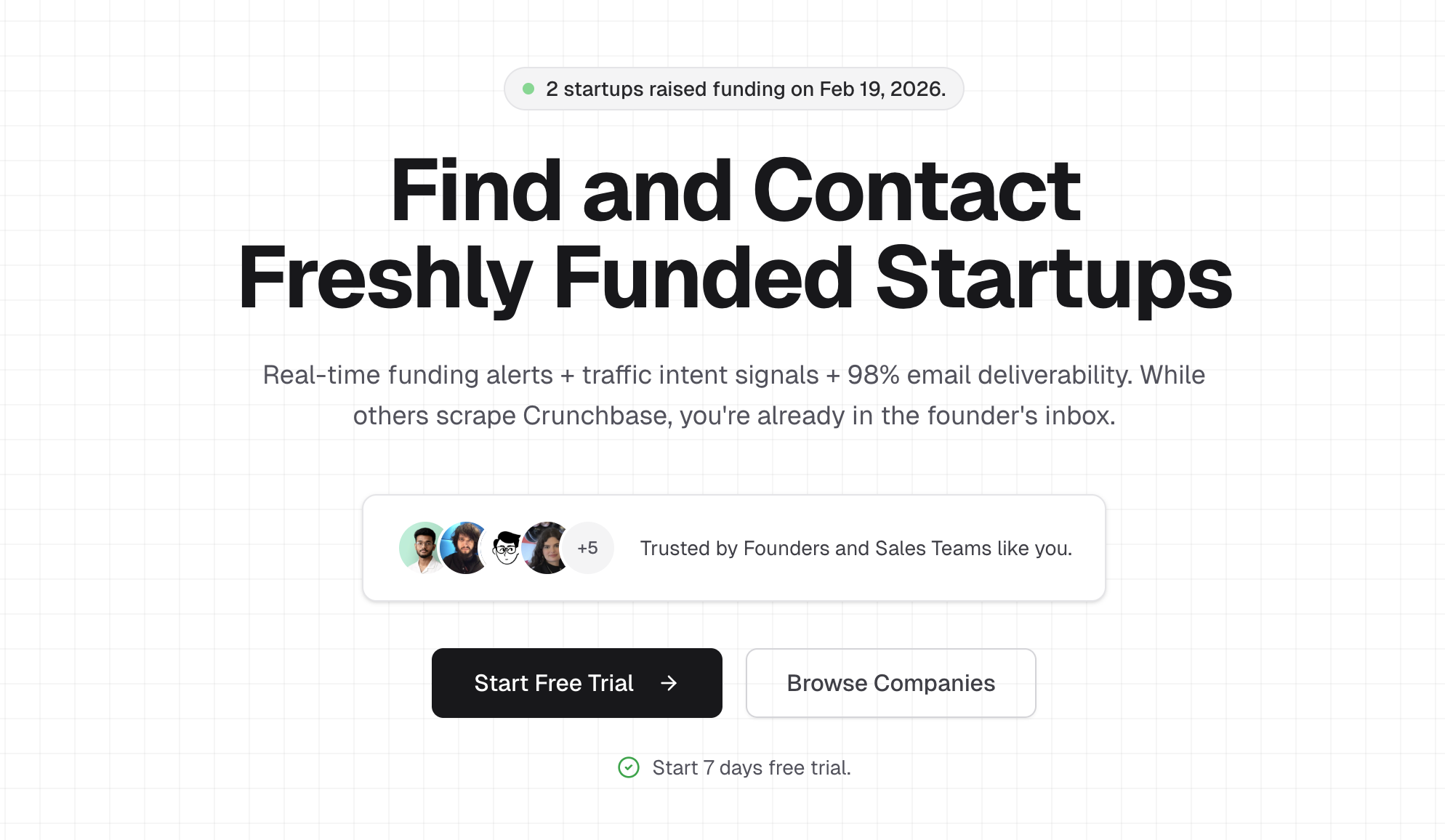
Here’s my unpopular opinion after 20 years selling around Silicon Valley: most outbound fails because it is late, not because it is bad. People obsess over database size because it feels measurable. Freshness is harder to see, so they ignore it. Then they email a founder six months after a raise and act surprised when they get ghosted.
Now I’m going to flip the tone mid-thought: if you are still buying “lists” that do not have a clear timing trigger, you are basically paying for rejection. The founder is not ignoring you because they hate your product. They are ignoring you because your email arrived after the decision was already made.
If you want a clean “why now” signal, funding is one of the best. That is the whole point of using a funding-trigger source like JustRaisedFunding instead of starting with a giant general database.
Related article for picking lead databases overall: Best Startup Lead Databases
Table of contents
- What “just raised” should mean
- Keyword angles and search intent
- Ranking criteria for funding lead sources
- Comparison summary table
- Feature matrix
- Pros and cons of the main approaches
- Real conversion logic
- Related “converter” suggestions
- Example conversions
- Practical outreach scripts
- Verdict summary
What “just raised” should mean
Most people treat “just raised” like a vibe. Do not do that.
Use a window that matches how fast your buyers move:
- 0 to 7 days: best for agencies, recruiters, and tools that help them spend money quickly (hiring, marketing, finance ops, compliance).
- 8 to 14 days: best for software where they need to evaluate, not impulse buy.
- 15 to 30 days: still useful, but you are now competing with everyone else.
This matters more today because fundraising timelines have stretched. Carta reported that the median company raising a Series B in Q1 2025 waited 2.8 years since its Series A. So when a startup actually raises, it often represents a real internal milestone, not casual money floating in. That is a moment you can sell into.
Keyword angles and search intent
If you are publishing this for SEO, you want to cover a few closely related queries, not just the head term.
Primary keyword:
- startups that just raised funding
High-intent longtails that are usually easier:
- recently funded startups list
- startups funded this week
- companies that just raised money
- newly funded startups hiring
- series a startups hiring now
- how to find recently funded startups
Search intent is mostly commercial:
- “Give me a list”
- “Give me alerts”
- “Help me contact the right person”
- “Help me not waste time”
That’s why a funding-alert product like JustRaisedFunding funding alerts maps well to the intent. People are not doing research for fun. They want targets they can act on.
Ranking criteria for funding lead sources
Here is how I rank tools specifically for “who just raised” workflows.
1) Speed: how quickly it shows up after the announcement
If you find out two weeks later, you are not early. You are noise.
JustRaisedFunding claims it can notify you within minutes of a funding announcement, which is exactly what you want if you are trying to beat the first wave of inbound vendors.
2) Verification: can you actually contact someone without wrecking deliverability
You want verified emails, not scraped guesses.
JustRaisedFunding claims a 98% delivery rate guarantee and positions its contacts as verified.
3) Context: does it give you more than “Company X raised”
Context is what turns a generic email into a relevant one:
- hiring signals
- growth signals
- basic firmographic filters
- founder profile links
The JustRaisedFunding platform also mentions hiring signals and sentiment signals on its pricing page, plus traffic and growth context.
4) Export and workflow
You need to get the data into your process:
- CSV export
- clean dedupe
- stable list rules (date window, stage, geo)
5) Price and commitment
If you are early-stage, avoid anything that requires a six-month contract just to test.
JustRaisedFunding’s pricing page lists a 7-day free trial and flexible plans, which makes it easy to run a real test without ceremony. See: JustRaisedFunding pricing.
Comparison summary table
No links to competitors here. You can find them. This is about decision-making.
| Approach | Examples (no links) | What you get | What you miss | Best for |
|---|---|---|---|---|
| Funding alerts + verified contacts | JustRaisedFunding | Fast, actionable, “why now” built in | Not meant to cover every company on earth | Selling to startups right after a raise |
| Funding intelligence platforms | Crunchbase, PitchBook, Tracxn | Deep funding history and investor context | Often not built for verified contact workflows | Research, partnerships, investing, some outbound |
| General lead databases | Apollo, ZoomInfo, Lusha, Cognism, UpLead | Broad coverage across industries | Funding freshness is usually not the core product | General outbound beyond just VC-backed startups |
If you want to sell to funded startups specifically, start with a funding-trigger feed like freshly funded startup leads and then enrich inside your CRM if needed.
Feature matrix
| Feature | JustRaisedFunding | Funding intelligence platforms | General lead databases |
|---|---|---|---|
| Built around “just raised” timing | Yes | Yes, but varies by alerts | Not usually |
| Notifications fast enough to beat the crowd | Claims “within minutes” | Often yes, sometimes slower | Not the focus |
| Verified founder emails as a core output | Yes | Sometimes, varies | Yes, but not funding-driven |
| Hiring and growth context | Yes (site claims signals) | Sometimes | Sometimes |
| Easy for small teams to test | Yes (trial and simple plans) | Often expensive | Usually yes, but credits matter |
| Best at “sell this week” use case | Yes | Mixed | Mixed |
Pros and cons of the main approaches
Funding alerts (my default recommendation for startup selling)
Pros
- You are early.
- You have a legitimate reason to reach out.
- Your targeting stays tight by default.
Cons
- If you sell to non-VC businesses, it is the wrong signal.
- You still need a real outbound workflow.
Start here: JustRaisedFunding.com
Funding intelligence platforms
Pros
- Strong historical context.
- Investor and round details can help with personalization.
Cons
- Not always optimized for “I need verified contacts and exports right now.”
- Price can be heavy.
General lead databases
Pros
- Wide coverage.
- Useful for non-startup markets too.
Cons
- “Just raised” is usually a filter, not the product.
- Easy to drift into sending too much volume.
Real conversion logic
Most people talk about outreach like it is art. It is mostly math plus discipline.
Two useful benchmarks:
- Hunter’s analysis of 11M cold emails sent in 2024 reports an average reply rate around 4.1%, and shows smaller campaigns perform better (for example, 50 recipients or fewer averaging 5.8% vs larger blasts).
- Belkins’ 2025 benchmarks report average reply rates around 5.8%, and notes that 6 to 8 sentence emails performed best in their dataset (with higher opens and replies).
Here is a realistic planning model for a “just raised” segment.
Example: target 8 meetings in 30 days
Assumptions:
- 600 contacts total (founders plus 1 relevant leader)
- Delivered: 98% (you keep bounces low with verification)
- Reply rate: 5.8%
- Positive replies: 35% of replies
- Meetings booked: 40% of positive replies
Math:
- Delivered: 600 x 0.98 = 588
- Replies: 588 x 0.058 = 34
- Positive replies: 34 x 0.35 = 12
- Meetings: 12 x 0.40 = 5
So you are short. That’s normal.
How you fix it without spamming:
- tighten your ICP to raise positive reply rate
- use tighter lists (smaller batches often outperform)
- improve your “why now” line using the funding signal
- add one more channel (LinkedIn comment + DM, or a call)
This is why “freshness” matters. It improves relevance, which improves positives, which is what actually books meetings.
Related “converter” suggestions
Think of these as converters that turn “a funding list” into outcomes.
-
Dedupe and suppression lists Do not email customers, active opportunities, or people who opted out. Keep a suppression list.
-
Verification and bounce monitoring Even with verification claims, monitor bounces weekly. A good rule of thumb in outbound is to keep bounce rate under ~2% so you do not damage sender reputation.
-
Simple enrichment Add two fields:
- funding date (or week)
- one role relevance tag (founder, finance, revops, engineering)
- Sequencing guardrails If you are new, start with:
- 1 email
- 1 follow-up
- 1 LinkedIn touch That is it. More steps do not fix bad targeting.
- A tracking sheet you actually use If you cannot track touches, you will double-send and look careless.
If you want a funding-focused list to feed into this system, use JustRaisedFunding startup funding feed.
Example conversions
Example conversion A: recruiter selling search help
Segment:
- funded in last 14 days
- hiring signal present
- roles you place (finance, sales, engineering)
Volume:
- 200 contacts
If you hit:
- 6% replies (12)
- 50% positive (6)
- 60% booked (3)
Three meetings from 200 is solid if your deal size is meaningful.
Example conversion B: B2B SaaS selling to Seed and Series A
Segment:
- funded in last 7 days
- industry niche (one niche only)
Volume:
- 300 contacts
If your offer is tight, and your “why now” is real, you can push positive reply rate up even if overall replies do not move much.
This is the part people miss: the funding signal is not magic, it just makes your message less random.
Practical outreach scripts
Script 1: simple funding-trigger email (6 to 8 sentences)
Subject: Congrats on the round
Hi {{FirstName}} , congrats on the raise.
When teams raise, they usually have a short window where they are picking vendors and adding headcount.
We help {{ICP}} with {{one outcome}} without forcing a big implementation.
If it is useful, I can send 2 examples from teams at your stage and a rough price range.
If you are not the right person, who owns this?
Either way, congrats again.
This works better when your list is fresh. That is the whole point of using real-time funding alerts.
Script 2: quick LinkedIn DM
Saw you just raised. Congrats.
If you are sorting through vendor noise right now, I can send one tight example and pricing range. Want it?
Script 3: call opener (10 seconds)
Congrats on the funding. I’m calling because companies at your stage usually pick {{category}} tools in the first couple weeks.
If it is not relevant, I’ll hang up. Are you the right person for that?
Verdict summary
If your goal is to sell to startups, “just raised” is one of the cleanest timing signals you can use. The key is not just finding the funding news. The key is turning it into a list you can contact safely and quickly.
My recommendation:
- Use a funding-trigger source like JustRaisedFunding for freshness and timing.
- Keep your window tight (7 to 14 days).
- Run smaller, targeted batches.
- Measure replies, positives, and meetings, not just sends.
Then, for the broader tool comparison, read: Best Startup Lead Databases
No Code Jobs
Ready to get started?
Let's find you the perfect No Code Developer.